Is BDD sometimes overkill? When to use it, and when to skip it
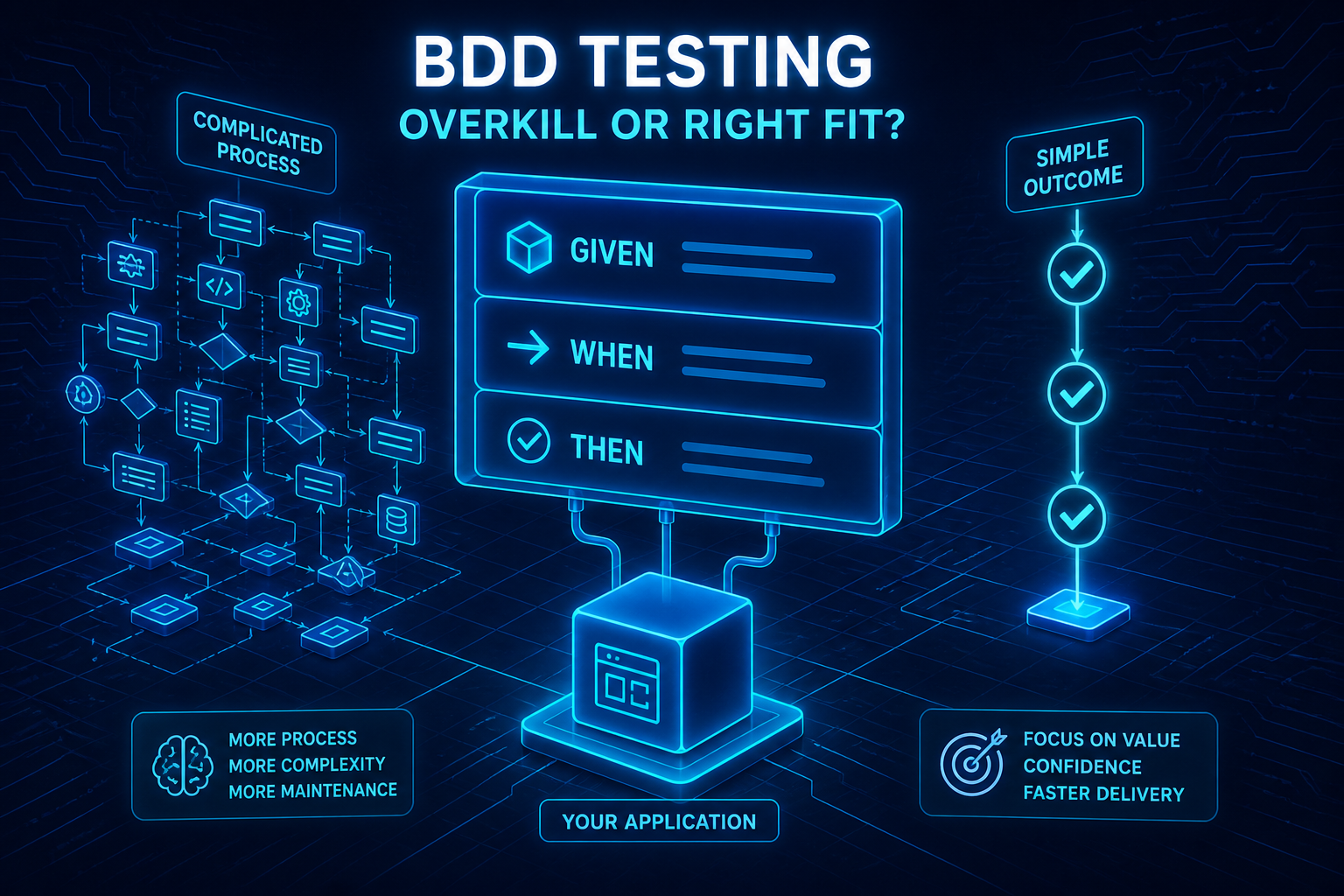
Behavior-Driven Development (BDD) promises a shared language between business and engineering: scenarios in Given/When/Then, living documentation, and tests that read like requirements. Used well, it reduces ambiguity. Used everywhere by default, it becomes ceremony.
So is BDD sometimes overkill? Yes. The useful question is not “is BDD good?” but “does this project’s risk and complexity justify the process cost?”
What BDD actually costs
Beyond writing the feature files, teams pay for:
- Agreeing on ubiquitous language and scenario style
- Keeping Gherkin in sync when the product pivots weekly
- Glue code (step definitions) that can become a second, fragile codebase
- Slower feedback if scenarios are wired as heavy end-to-end tests
- Training and discipline so “living docs” do not rot into dead files
None of that is free. On a greenfield MVP with one developer and a shifting scope, that overhead can exceed the value of the scenarios themselves.
When BDD is worth it
BDD shines when misunderstanding is expensive and behavior is the product:
- Complex business rules: billing, eligibility, compliance, multi-step workflows where “done” is easy to misread
- Multiple stakeholders: product, ops, legal, and engineering must agree on the same examples
- Long-lived domains: the system will outlive the people who built the first version
- Regression risk: small rule changes must not silently break edge cases
- Handoffs: agencies or rotating teams need executable examples, not tribal knowledge
In those cases, concrete examples (and preferably automated ones at the right layer) pay for themselves in fewer wrong builds and clearer backlog items.
When BDD is overkill
Skip or heavily scale down BDD when:
- You are validating an idea and the behavior will change tomorrow
- The “domain” is mostly CRUD, forms, and straightforward CRUD APIs
- One person owns product and code, so conversation already happens in the same head
- You would mostly rewrite UI clicks as Gherkin without capturing real rules
- The team lacks ownership: scenarios will be written once and never updated
A thin vertical slice with unit/integration tests and a short acceptance checklist often ships more value than a full Cucumber suite nobody trusts.
A practical middle ground
You do not need all-or-nothing BDD:
- Use examples where rules hurt: write Given/When/Then for pricing, permissions, and state machines; not for “user opens settings.”
- Automate at the right level: prefer testing domain behavior under the UI; reserve a few E2E paths for critical journeys.
- Keep scenarios short: one behavior per scenario; tables for variants, not novels.
- Treat Gherkin as a product artifact: if product will not review it, do not invent a parallel language for engineers only.
The takeaway
BDD is a tool for shared understanding under complexity, not a badge of maturity. On simple or highly exploratory work, it is often overkill. On rule-heavy, multi-stakeholder systems, it can be the cheapest way to stay honest about what “correct” means.
Choosing process is part of architecture. If you want a lightweight test and delivery approach tuned to your domain, talk to us.