AI in programming: how the developer role is changing, and whether we became QA + BA + engineer
A few years ago, a large part of a developer’s day was translating a ticket into boilerplate, lookups, and glue. Today, much of that first draft can appear in seconds. That does not mean software engineering disappeared. It means the scarce skill moved.
AI has changed how we work. The interesting question is what a developer is becoming, and whether the job has quietly merged with business analysis and QA.
What actually changed in day-to-day work
The loop got shorter and wider:
- From typing to directing: more time shaping intent, constraints, and acceptance criteria; less time hand-writing repetitive code
- From “how do I write this?” to “is this correct?”: review, security, edge cases, and system fit matter more than raw syntax recall
- From isolated tickets to whole slices: it is easier for one person to touch API, UI, tests, and docs in a single session
- From waiting on specialists to first-pass drafts: copy, diagrams, test cases, and SQL explorations start as drafts you refine
Velocity on greenfield and well-scoped tasks went up. The cost of confident-looking wrong answers went up with it.
What did not change
AI does not own accountability. Production incidents, data loss, and broken billing still land on humans and organizations. Architecture trade-offs, domain understanding, and taste (what to build, what to refuse, what to simplify) remain human judgment amplified by tools, not replaced by them.
Legacy systems, unclear requirements, and political constraints also remain. Models help you navigate them; they do not dissolve them.
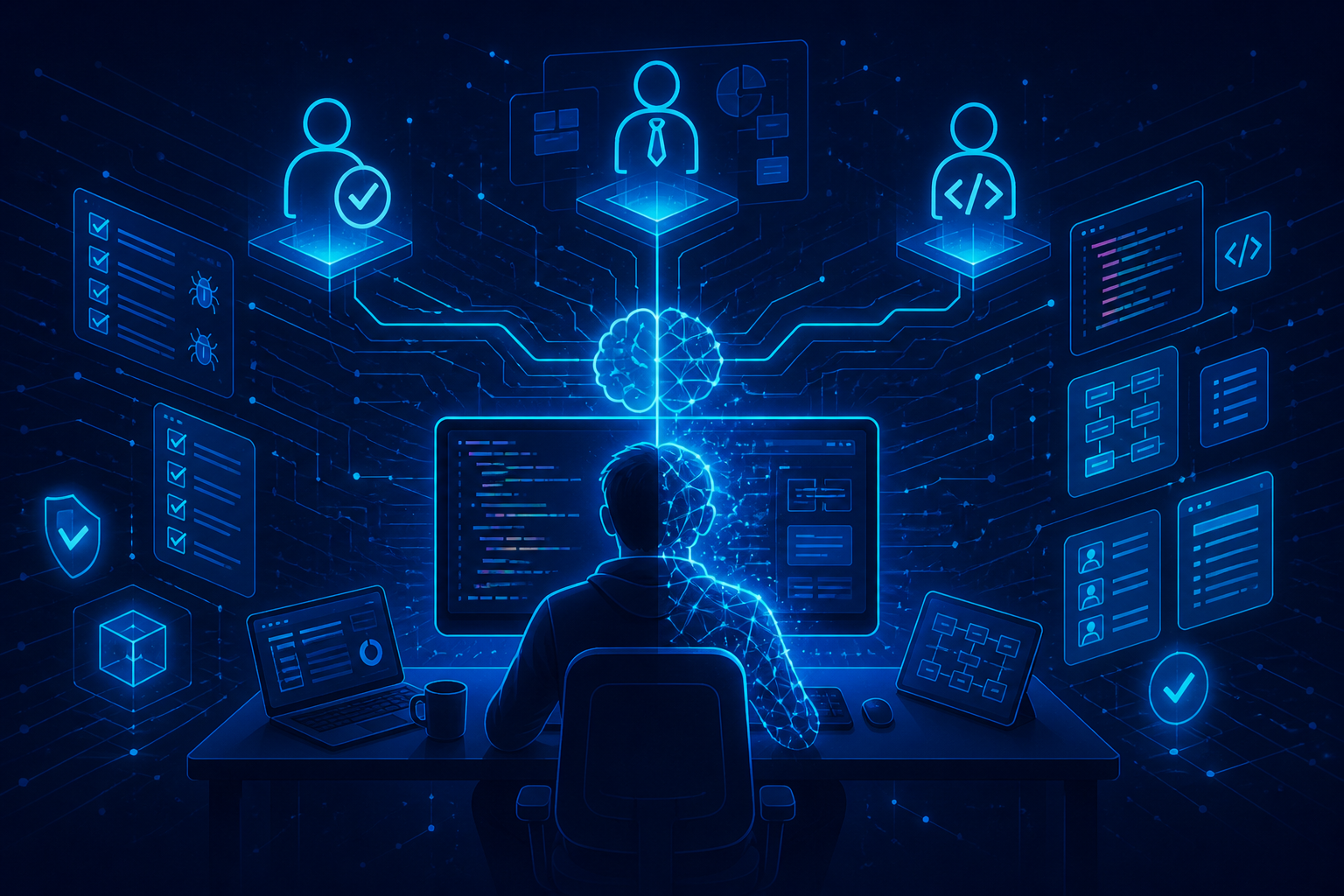
Has the developer become BA + QA + engineer?
In practice, partly yes, especially on smaller teams.
Business analysis overlap: Prompting well forces you to clarify actors, rules, and edge cases. Developers who used to wait for a perfect ticket now draft scenarios, question gaps, and propose scope cuts because the tool makes exploration cheap. That is BA work, whether or not the title says so.
QA overlap: Generating code without generating tests is how you get fast messes. Good AI-assisted workflows include adversarial prompting (“what breaks?”, “what’s missing?”), property ideas, and regression checks. Developers who ship AI output without a verification habit are not “full-stack”; they are unfinished.
Still not a full merge: Dedicated BAs still matter for stakeholder alignment at scale. Dedicated QA still matters for risk strategy, exploratory testing, and release quality on complex products. What changed is the default expectation that an engineer can carry more of the first mile of both.
A healthier mental model of the role
Think less “typist of code” and more owner of outcomes:
- Frame the problem: goals, constraints, non-goals
- Design the approach: boundaries, data, failure modes
- Generate and assemble: with AI where it is leverage
- Verify: tests, review, security, observability
- Ship and learn: measure, fix, simplify
In that loop, AI sits mainly in steps 3 and parts of 1-2 and 4. The developer remains responsible for the whole loop.
How strong teams use AI without lowering the bar
- Treat model output as a pull request from a fast junior: useful, never trusted blindly
- Keep architecture and security decisions explicit; do not outsource them to autocomplete
- Invest in tests and types so verification scales with generation speed
- Document the “why”: AI is weak at preserving team intent across months
- Use AI to reduce toil, not to skip understanding the domain
The takeaway
AI changed programming by compressing the distance between idea and draft. Developers who thrive are not the ones who ignore the tools, or the ones who paste without reading. They are the ones who absorb more product clarity and more quality ownership into the same role.
So yes: in many teams the modern developer already operates as a partial BA and QA. The title is still “engineer,” but the job is closer to accountable builder than to ticket-to-syntax translator.
We build with modern tooling and disciplined engineering: speed with judgment. If you want a team that uses AI without gambling on production, let’s talk.